


When Hamilton first opened at The Public Theatre in February 2015 it took the world by storm, receiving a record-setting 16 nominations at the 2016 Tony Awards. However it wasn’t just musical theatre enthusiasts who found themselves touched by the tale, but historians alike due to the factual nature of the two-act drama. Lin-Manuel Miranda, the writer and star of the show, has said in interviews that he “felt an enormous responsibility to be as historically accurate as possible,” but with the attention gained from academics all across the world comes the inevitable questions surrounding the musical’s authenticity: was Alexander Hamilton really the forward-thinking, liberal figure he is presented as … if so, why are we only hearing about him now?
Firstly, is arguably the most pressing question in everyone’s mind: if Hamilton had not been shot by Aaron Burr in a duel on July 11, 1804, would he have gone on to make great reforms to America’s laws surrounding slavery, possibly leading to its abolition before 1865? It is undeniable that he was against slavery: he was a founding member of the New York Manumission Society, created in 1785 which, among other things, pushed for a gradual emancipation law in New York State. In the show’s last song, his widow, Eliza, sings that Hamilton would have “done so much more” against slavery had he lived longer. But, while Hamilton publicly criticised Jefferson’s views on the biological inferiority of blacks, his record from the 1790s until his death in 1804 includes little to no action against slavery. Furthermore, the slave holdings of the Schuyler family, which Hamilton married into in 1780, go unmentioned, along with the long-standing debate amongst historians as to whether Alexander Hamilton himself, owned slaves. Extracts from his personal writings commonly reference to his and his wife’s ‘servants’ (his cash books for Elizabeth’s travel in 1789 citing ‘cash paid for passages of yourself and servant’), lending itself to the idea that he did participate in the institution of slavery. However, although the image of Hamilton the ardent lifelong abolitionist is highly questionable and idealised for dramatic effect, he was real contrast to Jefferson (who owned over 600 African-American slaves throughout his adult life), making him an abolitionist by the standards of the founding period.
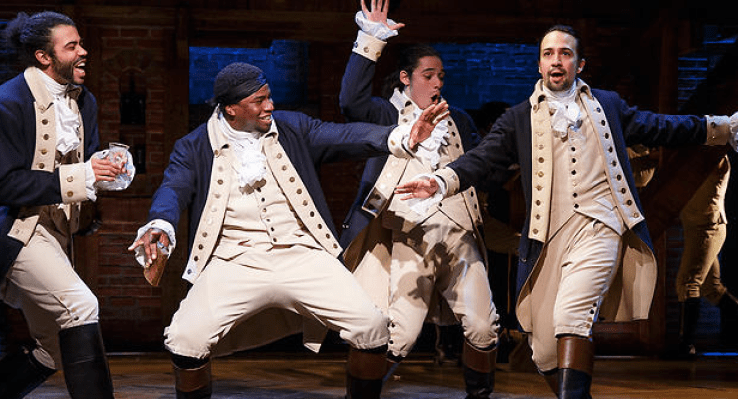
In the opening number of the musical, Hamilton declares himself to be ‘a bastard, orphan, son of a whore’ who was ‘dropped in the middle of a forgotten spot in the Caribbean, impoverished, in squalor’. There is a large degree of fact to these statements, from his family history to where he grew up. Rachel Faucette, a married woman, had Alexander and his older brother James Jr. out of wedlock leading to accusations of adultery. She lost her modest fortune in divorce and abandoned by her common law husband (and the boys’ father) James Hamilton, leaving her in relative ‘squalor’ until she contracted yellow fever and died on February 19, 1768, leaving Hamilton and ‘orphan’. It is also accurate that Hamilton did spend his childhood in a ‘spot in the Caribbean’, as he was born and spent much of his childhood in Charlestown, the capital of the island of Nevis in the Leeward Islands (then part of the British West Indies), where his mother moved with James Hamilton after having inherited a seaside lot in town from her father.
It is arguably impossible to thoroughly judge the accuracy of the entire play without compromising the fascination of the story, with many questions still remaining unanswered and debated even now. It is also impossible to correctly judge the play and its content without considering why and when it was written: as a modern audience, we have a habit of favouring a nostalgic history; wanting “to save the founders from that story of the original sin of slavery, we put more emphasis on founding fathers who in some ways raised critique of slavery at the time,” as said by Renee C. Romano.


 Grace - Upon - Paper